
Electrical Steel Explained: A Practical Guide to Grades, Loss, and Applications
Electrical Steel Explained: A Practical Guide to Grades, Loss, and Applications
Electrical steel is a specialized iron-silicon alloy used to make magnetic cores in transformers, motors, generators, and other electromagnetic equipment. It is also known as silicon steel or lamination steel. This material is designed to conduct magnetic flux while minimizing energy losses, which makes it one of the most important inputs for energy-efficient power systems.
For buyers entering the electrical steel market, the first challenge is not finding a supplier. It is understanding how the material is classified, which parameters control performance, and why the same alloy family is used across distribution transformers, industrial motors, electric vehicle drivetrains, generators, and household appliances.
This guide provides a seller-neutral, application-focused introduction to electrical steel: what it is, how grain-oriented and non-oriented grades differ, what the numbers on a data sheet mean, how real projects use different grades, and how a buyer should approach sourcing.
The Problem: Electrical Steel Looks Simple, but Selection Is Not
Electrical steel is often summarized as “silicon steel,” but that shorthand hides a wide range of specifications. A buyer researching electrical steel for transformers may encounter terms such as Hi-B, grain-oriented, non-oriented, low loss, high permeability, laser-scribed, and high-frequency grades. Each term points to a different balance between cost, efficiency, and manufacturing behavior.
The practical problem for an awareness-stage buyer is that most online content either lists product names without context or pushes a single grade. Without a clear framework, a procurement team can easily request the wrong thickness, misread iron loss values, or choose a material that does not meet local energy-efficiency regulations.
The solution is to start with application requirements, then map them to material type, key parameters, standards, and supplier processing capabilities.
Industry Background: A Market Driven by Electrification and Efficiency
The electrical steel market is expanding in parallel with global grid upgrades, electric vehicle production, and industrial motor efficiency programs. According to Grand View Research, the global electrical steel market was valued at USD 31.0 billion in 2025 and is projected to reach USD 47.0 billion by 2033, growing at a CAGR of 5.5% from 2026 to 2033.
China is the largest producing country. Chinese Society for Metals data cited by MarketReportsWorld shows that China’s electrical steel production reached 16.1 million tonnes in 2024, a 5.4% year-on-year increase. Export activity is also strong: Shanghai Metals Market reported that China’s export volume of grain-oriented electrical steel reached 393,200 metric tons in H1 2025, up 16.0% year on year.
Demand is increasingly tied to electrification. Precedence Research notes that non-grain-oriented electrical steel consumption for the automotive sector, specifically electric vehicles, accounted for more than 34% of total demand in 2024. At the same time, the supply side remains concentrated. MarketsandMarkets identifies Baosteel (China Baowu), POSCO, and Nippon Steel as the top three global producers of high-grade electrical steel.
For buyers, these market dynamics mean three things. Supply of high-grade material is controlled by a small number of producers. Export channels are active but require verification. And the application mix is shifting from traditional industrial transformers toward EV motors, renewable-energy equipment, and high-efficiency distribution transformers.
Detailed Solution: Understanding Electrical Steel Types and Key Parameters
Grain-Oriented vs. Non-Oriented Electrical Steel
Electrical steel is broadly divided into two families.
Grain-oriented electrical steel (GOES) is processed so that the magnetic properties are strong in one rolling direction. This makes it the preferred material for transformer cores, where the magnetic path follows an aligned direction. Grain-oriented grades are commonly found in distribution transformers, power transformers, and HVDC converter transformers.
Non-oriented electrical steel (NGOES) has more uniform magnetic properties in all directions. It is used in rotating machines such as motors, generators, alternators, and certain small transformer applications. Standards such as ASTM A677 define core loss and permeability limits for non-oriented grades.
High Magnetic Induction Hi-B Steel
Many modern transformer grades belong to the high magnetic induction grain-oriented silicon steel family, often shortened to Hi-B. Hi-B steel is characterized by high magnetic flux density, which allows a transformer core to carry more magnetic flux for the same cross-section. The result can be a smaller core, lower copper loss, and improved overall efficiency.
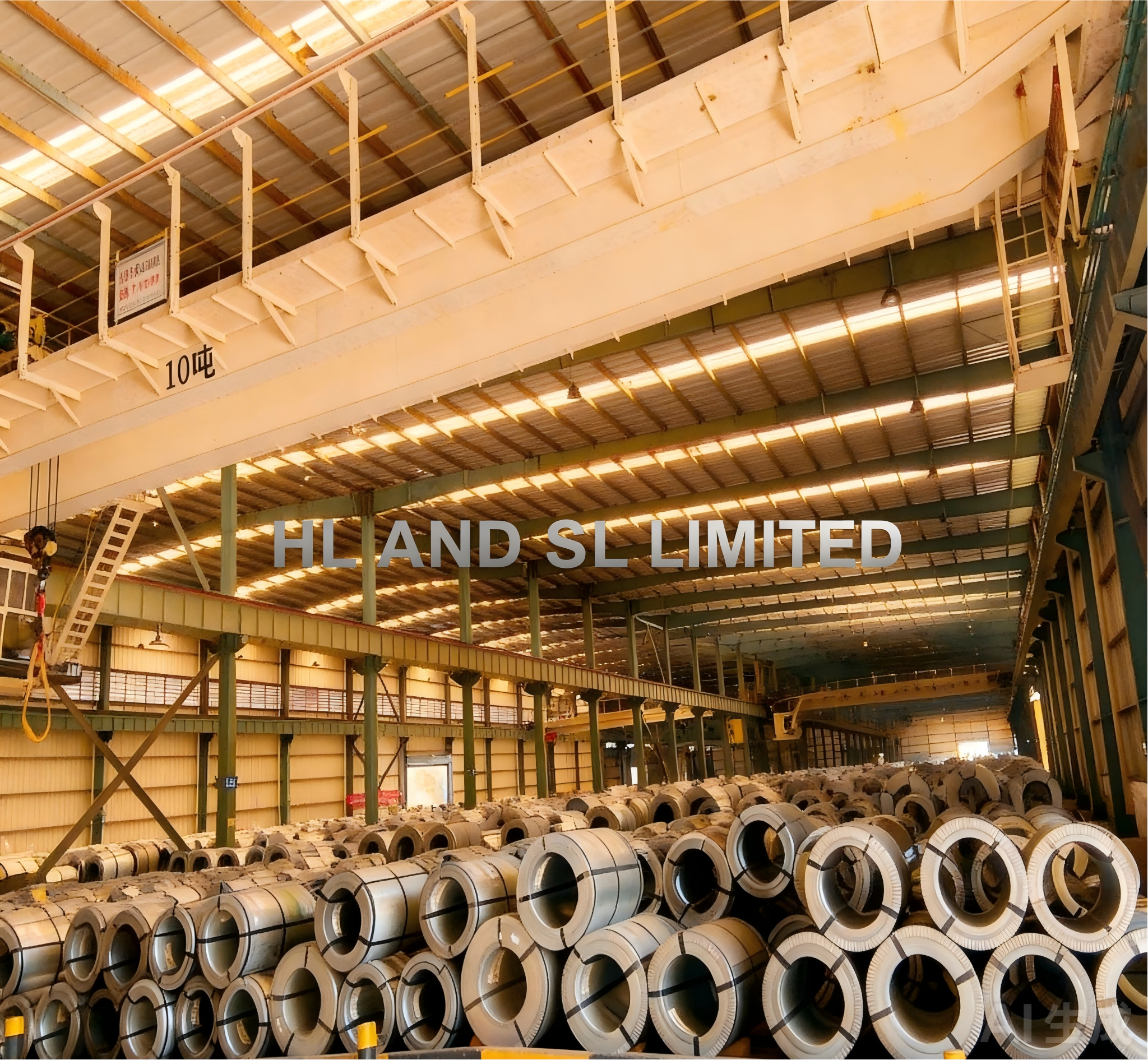
HL AND SL LIMITED carries a range of Hi-B oriented silicon steel grades for transformer and motor applications. The company, established in 2012, specializes in the export trade of electrical steel and is an authorized agent of China Baowu Steel Group. Its manufacturing facility covers 30,000 square meters with an annual production capacity of 30,000 tons, supported by an R&D team of 10 engineers.
Key Data-Sheet Parameters
Three numbers matter most when comparing electrical steel grades.
Thickness is the strip thickness in millimeters. Thinner laminations reduce eddy current losses, especially at higher frequencies. Common transformer thicknesses are 0.23 mm, 0.20 mm, and 0.18 mm.
Iron loss (often written as P1.7/50) is the core loss measured at 1.7 Tesla and 50 Hz. It is expressed in watts per kilogram. Lower iron loss means less energy converted to heat, which is critical for transformer efficiency.
Magnetic flux density (often written as B8) is the magnetic induction at a field strength of 800 A/m, expressed in Tesla. Higher flux density allows more power to pass through a smaller core.
For Hi-B grades, the material is primarily iron with about 3.0%–3.2% silicon, plus small additions of aluminum and manganese. Impurities such as carbon, sulfur, and nitrogen are strictly controlled to preserve magnetic performance.
Comparison Table: Oriented Electrical Steel Grades at a Glance
The table below shows the core specifications for common Hi-B oriented silicon steel models in the HL AND SL LIMITED portfolio. All values are taken from verified product data sheets.
| Model | Thickness | Iron Loss (P1.7/50) | Magnetic Flux Density (B8) | Typical Applications |
|---|---|---|---|---|
| 18-65 | 0.18 mm | ≤0.65 W/kg | ≥1.88 T | Ultra-high voltage transformers, power transformers, high-efficiency energy-saving transformer cores |
| 20R070 | 0.20 mm | ≤0.70 W/kg | ≥1.86 T | High-efficiency distribution transformers, power transformer cores |
| 23Q080 | 0.23 mm | ≤0.80 W/kg (measured 0.76–0.78) | ≥1.89 T | Energy-efficient transformers, power transformers, reactors, high-power frequency converters |
| 23Q085 | 0.23 mm | ≤0.85 W/kg | ≥1.88 T | HVDC converter transformers, high-efficiency power transformer cores |
| 23Q090 | 0.23 mm | ≤0.90 W/kg | ≥1.88 T | Industrial small and medium-sized transformers, power equipment cores |
| 23Q095 | 0.23 mm | ≤0.95 W/kg | ≥1.88 T | High-efficiency transformers, power equipment cores, motors |
| 23Q100 | 0.23 mm | ≤1.00 W/kg | ≥1.75 T | Common distribution transformers, general industrial transformers, electromagnetic equipment |
| 27Q120 | 0.27 mm | ≤1.20 W/kg | — | Small and medium-sized transformer cores and electrical equipment |
Step-by-Step Breakdown: How to Choose Electrical Steel
Step 1. Define the End Application
Start with the equipment that will use the core. A distribution transformer, an HVDC converter transformer, an industrial motor, an electric vehicle traction motor, and a small household appliance motor have different loss and frequency requirements. The application determines whether grain-oriented or non-oriented steel is appropriate.
Step 2. Choose the Material Family
For transformer cores, oriented silicon steel is the standard because the magnetic flux follows a controlled path. For motors and generators, non-oriented steel is usually preferred because flux rotates around the stator and rotor.
Step 3. Set Loss and Flux Targets
Use the data sheet to match the design loss target. For example, an ultra-high-efficiency transformer project may require a thin grade such as 18-65 with iron loss ≤0.65 W/kg. A standard distribution transformer may be satisfied by 23Q100 with iron loss ≤1.00 W/kg.
Step 4. Check Standards and Certification Requirements
Material-level standards such as ASTM A677 for non-oriented steel and IEC 60404-8-4 for cold-rolled non-oriented strip help define acceptable performance. Regional projects may add specific certification. In Brazil, for example, oriented silicon steel used in local transformer production must meet INMETRO energy-efficiency requirements.
Step 5. Evaluate Processing and Customization Needs
Electrical steel is rarely used as a full-width coil. Most buyers need slitting, shearing, laser cutting, stamping, or custom packaging. Suppliers with in-house processing capability can deliver materials that are ready-to-use. HL AND SL LIMITED owns a material processing plant that provides secondary processing based on customer size, shape, and performance requirements.
Step 6. Qualify the Supplier
Check the supplier’s upstream relationships, annual capacity, export experience, and documentation. HL AND SL LIMITED exports 80% of its sales, with major markets including Mexico, Brazil, Italy, the UAE, and India. Stable access to China Baowu steel resources also helps secure consistent material quality.
Use Cases: Electrical Steel in Real-World Projects
Germany: Distribution Transformer Upgrade Project
Germany’s distribution transformer upgrade program is driven by EU eco-design regulations. The operating environment is mild, with temperatures between 0°C and 30°C and a stable grid, but noise restrictions are strict. The application calls for core material that reduces no-load and load losses, meets an iron loss requirement of ≤0.60 W/kg, achieves noise levels 2–3 dB below standard requirements, and has coating weather resistance suited to the German West Coast coastal area.
Projects like this show why a single standard grade is rarely enough. Coating, noise behavior, and loss performance must be considered together.
Canada: High-Efficiency and Low-Noise Transformers in Cold Regions
In Canada, distribution transformers must operate through extreme winters with temperatures from -40°C to -20°C, freeze-thaw cycles, and occasional coastal salt fog. The project described in the supply corpus uses oriented silicon steel B20HS070 to manufacture national Class 1 energy-efficient rolled iron core transformers. The material must maintain at least 95% of its magnetic permeability at -40°C while delivering very low iron loss and satisfying high noise-control requirements.
This use case highlights the importance of low-temperature magnetic stability, especially for grid equipment installed outdoors.
Brazil: Power Transmission and Distribution Transformers
Brazil is the largest power market in Latin America. In one application scenario, oriented silicon steel is used as core material for power and distribution transformers serving the Brazilian national grid. The climate is tropical, with high humidity and a small day-to-night temperature difference. The material must satisfy INMETRO energy-efficiency certification for local transformer production, and the grid operates continuously under full load.
For Brazilian transformer manufacturers, compliance with local certification is as important as magnetic performance.
Brazil: ±800 kV HVDC Converter Transformer Project
In the Belém Mountain Phase II ultra-high-voltage direct current project, electrical steel is used for converter transformer cores. The line transports hydropower from northern Brazil to southeastern load centers. The project operates in bipolar mode at ±800 kV / 4000 MW for long-term continuous operation. The material must withstand high temperature and high humidity (30–40°C, 80%–90% humidity) and provide high magnetic flux density of at least 1.92 T with iron loss below 0.85 W/kg.
HVDC projects demand the most consistent material quality because any core loss increase is multiplied across a very large power rating.
Frequently Asked Questions
1. Do electrical steel products need CE or UL certification?
Electrical steel is usually specified against material standards such as ASTM A677 for non-oriented grades and IEC 60404-8-4 for cold-rolled non-oriented strip. CE and UL marks generally apply to finished electrical equipment rather than to the steel coil itself. In Brazil, oriented silicon steel used in local transformer production may need to satisfy INMETRO energy-efficiency certification. Buyers should confirm which certification applies to the finished transformer or motor with their equipment manufacturer.
2. What electrical steel grades support high-efficiency transformers and motors?
For high-efficiency distribution transformers, grades such as 20R070 (0.20 mm, ≤0.70 W/kg) and 23Q080 (0.23 mm, ≤0.80 W/kg) are common choices. For HVDC converter transformers, 23Q085 is designed for that role. For motor cores and power equipment, 23Q095 can be used. The 18-65 grade targets ultra-high-voltage transformers and high-efficiency energy-saving transformer cores. The final selection should always be confirmed against the core design and loss budget.
3. How does electrical steel price vary by grade?
There is no fixed industry price list because electrical steel cost depends on thickness, iron loss, magnetic flux density, order volume, coating type, and secondary processing. High-performance grades with lower iron loss and thinner gauge generally sit at a higher price level. A supplier with access to multiple mill sources can offer both economy and premium grades, allowing buyers to match performance to budget. Request a quotation for a specific grade to get an accurate price.
4. Can I request samples of electrical steel before placing a bulk order?
Yes. Buyers are advised to request samples after defining the grade, thickness, coating, and processing requirements. Contact HL AND SL LIMITED by email at sales-01@hlslind.com or by WhatsApp at +86 134-6700-2282 to discuss sample availability and qualification.
5. How long does electrical steel delivery usually take?
Lead time is not fixed. It depends on grade availability, coil width, coating type, volume, and whether cutting or stamping is required. HL AND SL LIMITED operates an in-house material processing plant and is an authorized agent of China Baowu Steel Group, which helps stabilize supply. To get an accurate lead time, submit your target grade and delivery schedule for a quote.
Conclusion: Start with the Loss Target, Then Build the Supply Chain
Electrical steel selection is less about memorizing grade names and more about connecting application requirements to measurable material properties. For transformer projects, the decision path is: define the loss target, confirm the magnetic flux density, check local compliance, then choose a grade that can be supplied with the required processing.
For motors, generators, EVs, and household appliances, the same framework applies. The material must fit the operating frequency, the core geometry, and the efficiency standard that the finished equipment must meet.
HL AND SL LIMITED provides a practical sourcing route for electrical steel buyers at the awareness and research stage. With an established export record, a 30,000-ton annual capacity, in-house processing, and authorization as an agent of China Baowu Steel Group, the company is positioned to support both standard transformer grades and more demanding energy-efficiency projects.
Next step: If you are evaluating electrical steel for transformers, motors, or custom core processing, request a sample or quotation from HL AND SL LIMITED.
Contact: Lucas | Email: sales-01@hlslind.com | Tel/WhatsApp: +86 134-6700-2282
Website: www.hlslind.com
Download the company brochure: HL AND SL LIMITED Electrical Steel Brochure (PDF)
Have Questions or Need More Details?
Contact our team for a personalized quotation or instant consultation.
Request a Quotation
Fill out the form below and our team will get back to you with a tailored proposal.
WhatsApp Direct Chat
Prefer to chat in real-time? Message us on WhatsApp for instant assistance & quick answers.
- Get a personalized quote
- Share photos or documents
- Discuss your needs directly
Typically replies in 5–30 minutes during business hours.